
PixelYourSite Pro 12.6.8 Nulled? Tracking Tests & Download
PixelYourSite Pro 12.6.8 download, dated add-on bundle and a bounded WordPress tracking test: native event values, script registration and pausing, with browser-call evidence kept separate from real Meta delivery.
PixelYourSite Pro v12.6.8 Free Download
Test record: 2026-10-16 · WordPress 7.1.3; PHP 8.4.26; isolated synthetic WordPress lab. Four native PHP checks passed. Chrome profile blocked packaged public.js and dependencies with ERR_BLOCKED_BY_CLIENT; browser event execution and Meta delivery were not validated. Dummy pixel only; Conversions API, advanced matching and unrelated platforms disabled. Add-ons inventoried only.
What PixelYourSite Pro is for
PixelYourSite connects WordPress activity to advertising and analytics tags. It is useful when a site owner needs consistent event names, values and rules without maintaining separate snippets throughout a theme. Pro offers a broader set of integrations and event controls, but installing it does not make a conversion report accurate by itself.
The vendor’s comparison lists Meta Pixel and Conversions API in both Free and Pro. Pro adds features such as additional advertising platforms and richer event configuration. Choose against the events and integrations you actually need; a simple site using a basic Meta pixel may not need Pro. Our test concentrates on one native custom event rather than trying to validate the whole feature list.
What changed in 12.6.8
The official changelog dates 12.6.8 to 14 October 2026. It describes product-feed ID checking, shared product-ID settings, a WooCommerce purchase trigger with product conditions, Klaviyo Forms and Awin support. It also lists server Purchase retries, saved order consent and fixes affecting duplicate CAPI events, ProfitConversion, update detection and noscript output.
These are developer release notes, not results from our fixture. We did not run a checkout, test the server-event queue, reproduce the reported defects or assess the security fix. The bounded tests below cannot establish that every listed change works on an existing store.
The test setup
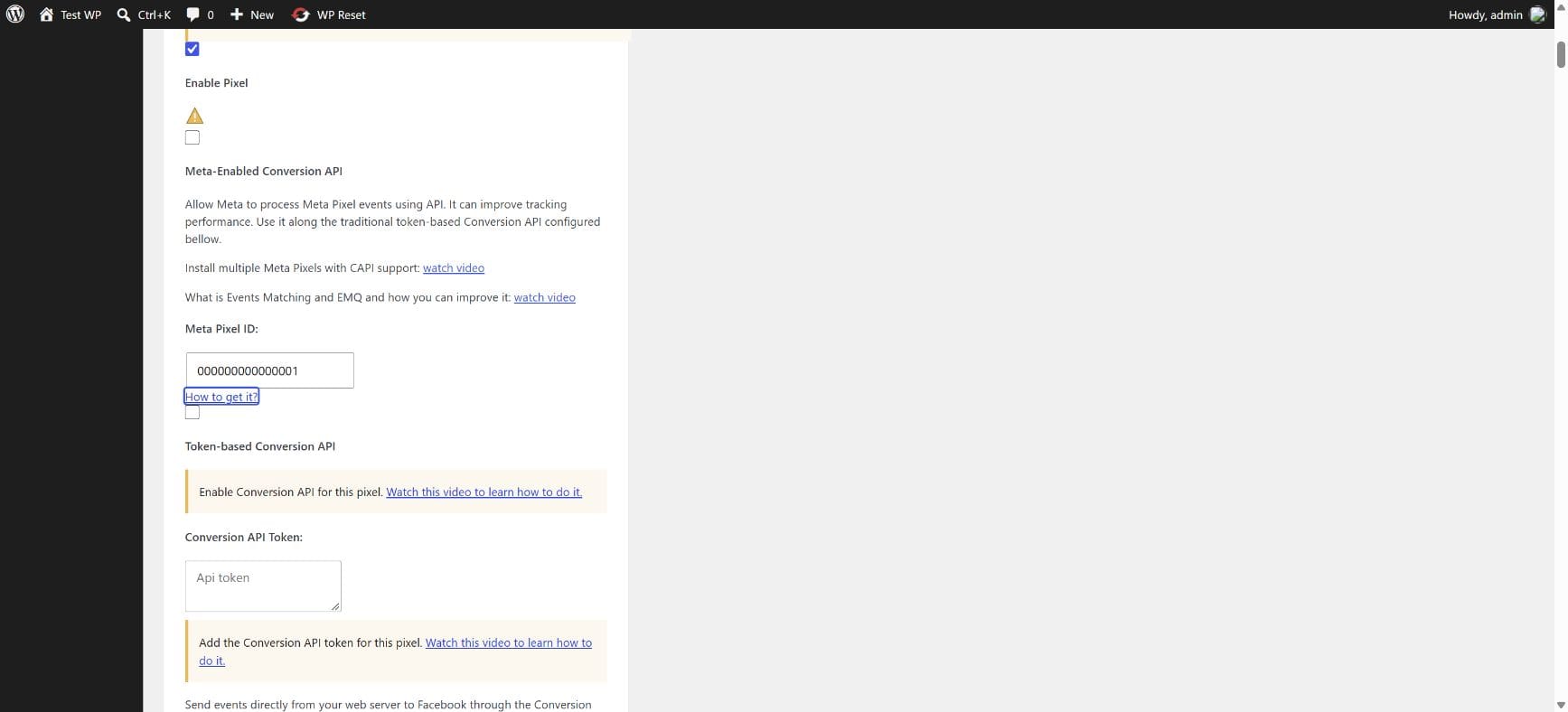
We used an isolated WordPress installation and the supplied main plugin ZIP. The fixture configured one synthetic Meta pixel ID, 000000000000001, and kept Conversions API and advanced matching off. Other tracking platforms were disabled for the exercise. No real advertising account, access token, customer identity, payment or order was used.
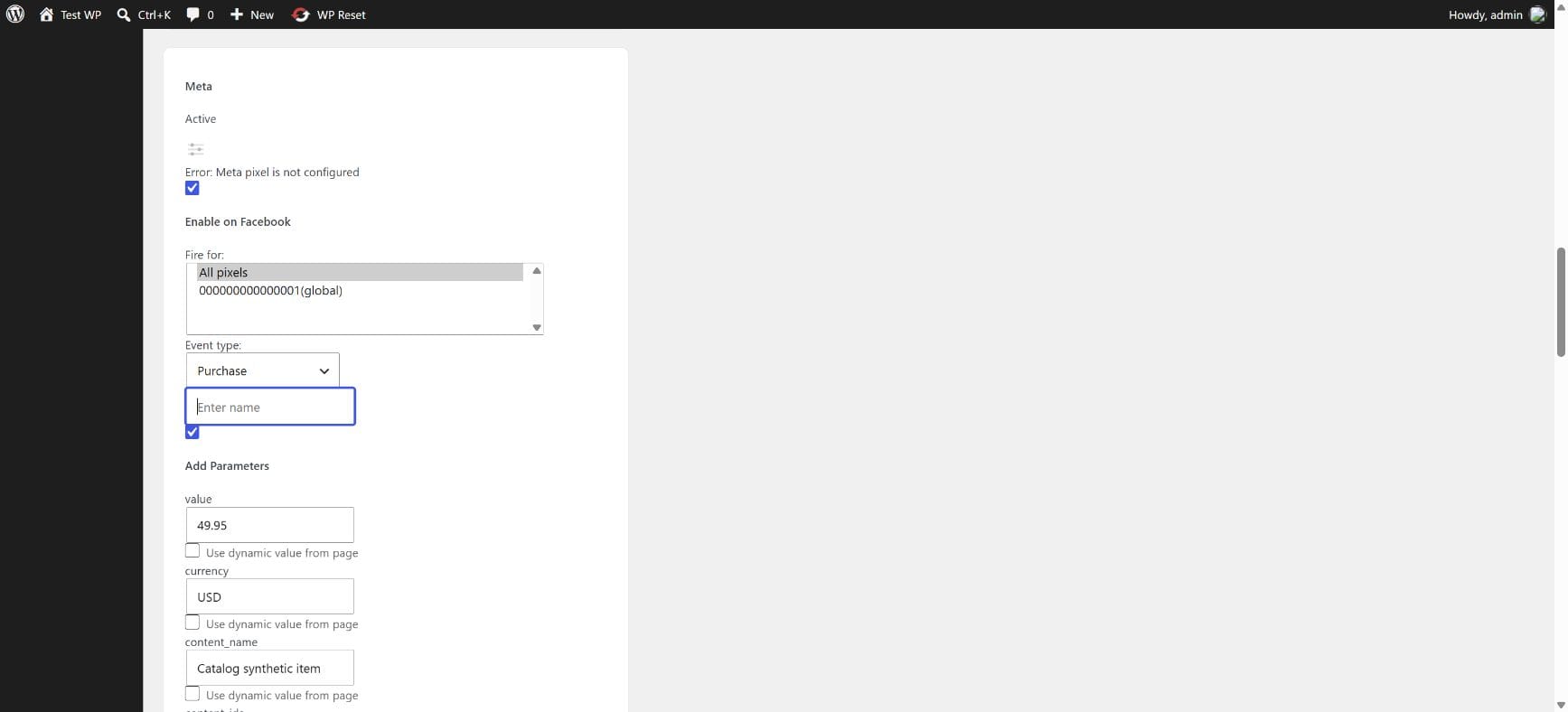
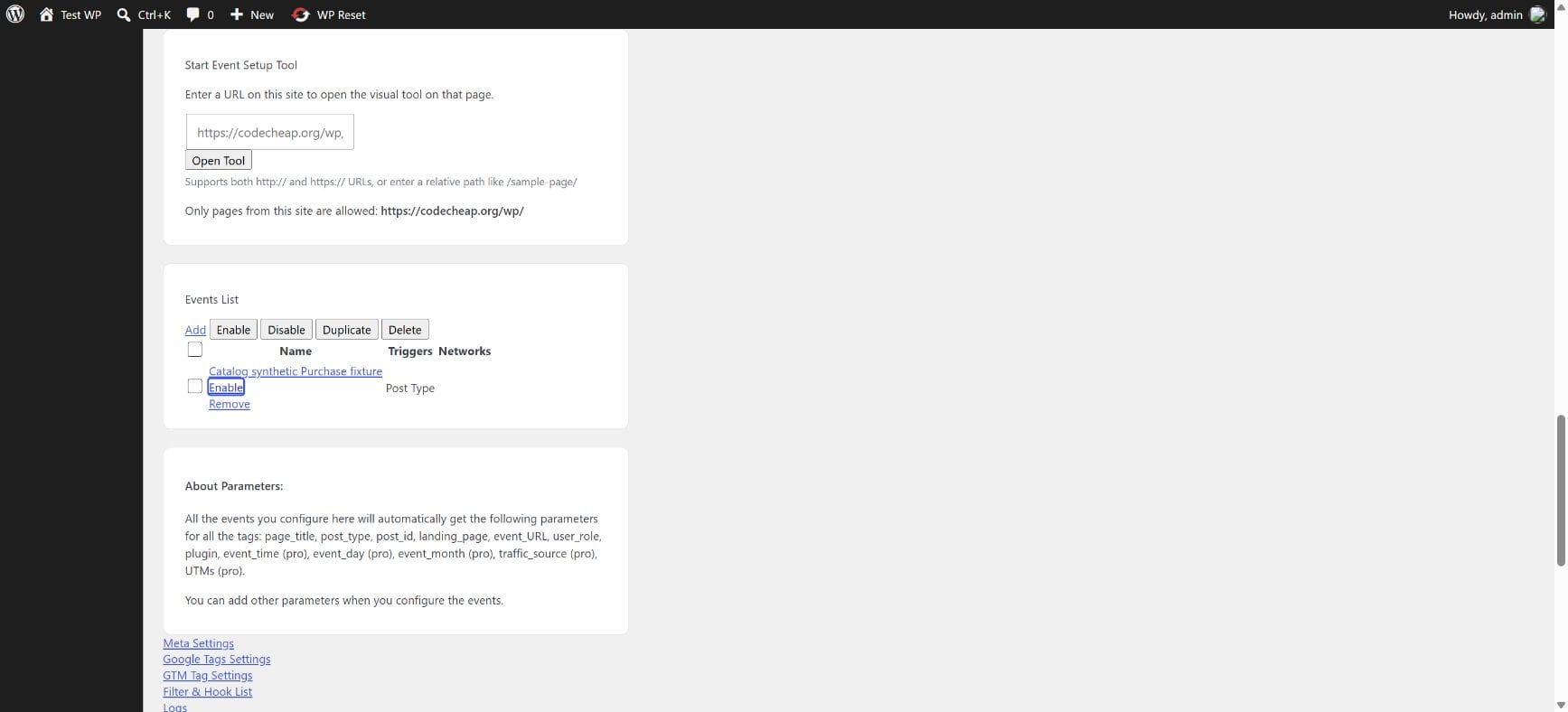
A native custom event named Purchase carried a fixed value of 49.95 and currency USD. Its trigger was the page post type. This was a deliberately synthetic event on a test page, not a completed sale. The custom-event data and emitted settings came from the plugin’s own APIs and event manager.
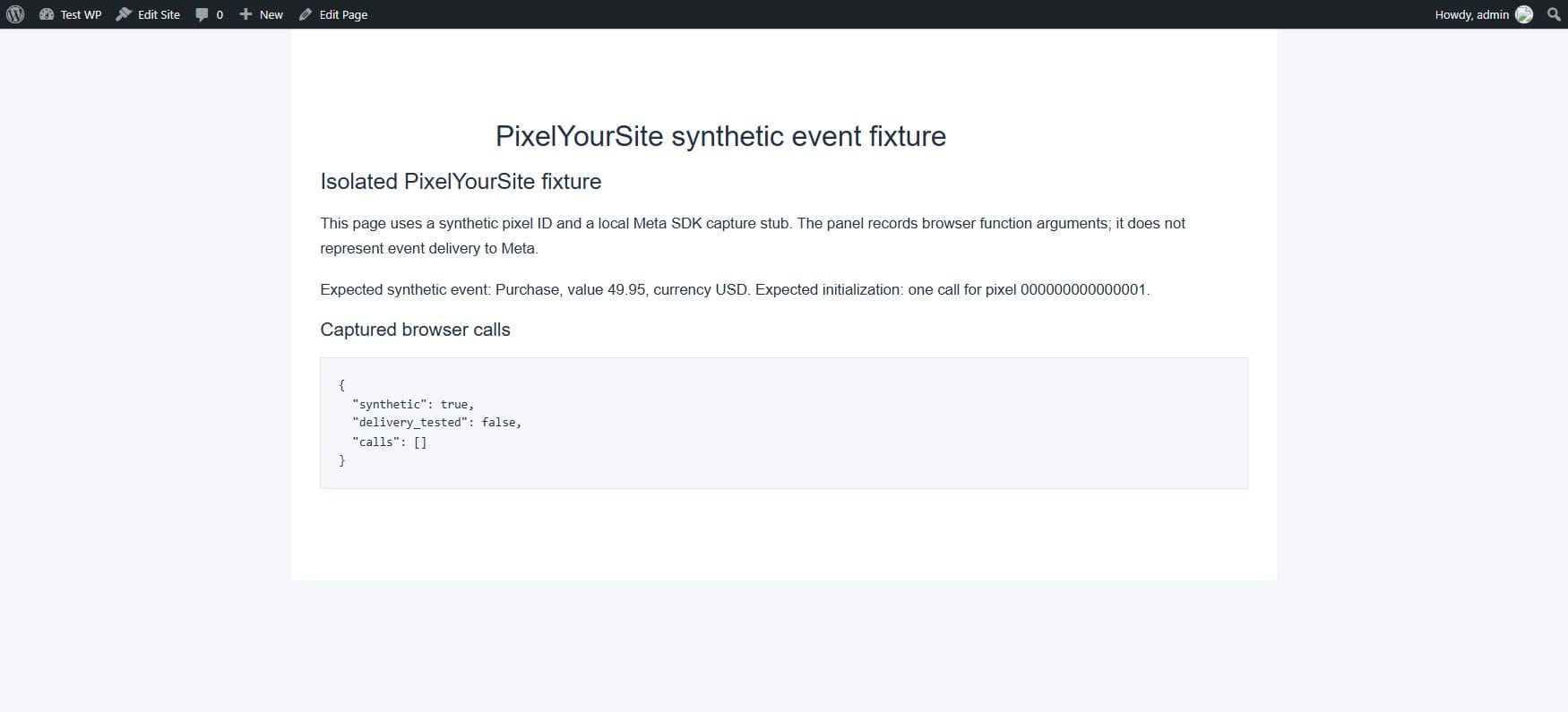
A local capture function stood in for the external Meta SDK. It can record arguments passed by the plugin’s browser JavaScript; it cannot report an event received by Meta. The lab blocked external delivery. The distinction matters: a correct local call is one checkpoint before a working tracking integration, not a substitute for destination-side verification.
- Activate the supplied plugin in a disposable staging installation and open its dashboard once to complete native first-run migrations.
- Configure only a synthetic pixel and disable server delivery and unrelated platforms. Create the native event with known fixed values.
- Check the native emitted configuration and the actual browser capture separately. Compare the event name, value and currency with the fixture definition.
- Pause the custom event and request the page again. Test any real site cache independently before relying on a production change.
The downloadable fixture contains synthetic event data, a manual reproduction specification and a README. It is not an executable installer or a copy of the lab database. Follow the native administrator migration step before setting test options, and keep the dummy/no-delivery settings confined to disposable staging.
Recorded tracking checks
Four native PHP checks passed on 16 October 2026. They inspect the plugin’s own emitted configuration, event payload and WordPress script registration. The separate browser attempt did not validate JavaScript execution: the Chrome profile blocked the plugin’s public script and dependencies. These are separate outcomes, and the table keeps their boundaries visible.
| Check | Observed result | What it establishes |
|---|---|---|
| Synthetic configuration — PASS | Only pixel 000000000000001; serverApiEnabled false | Native emitted settings use the intended dummy configuration. |
| Custom event data — PASS | One Purchase payload; value 49.95; currency USD | Native PHP generation carries the expected event and fixed parameters. |
| Repeated enqueue — PASS | One pys handle and one pysOptions declaration | Repeated enqueue calls do not duplicate these registrations in this request. |
| Paused event — PASS | Zero Purchase payloads; dummy pixel still configured | A fresh request omits the paused event without disabling the platform. |
| Browser execution — NOT VALIDATED | Capture calls []; public.js and dependencies ERR_BLOCKED_BY_CLIENT | This browser attempt cannot prove client event calls or destination delivery. |
For the value check, the emitted parameter was the string "49.95" and the numeric assertion compared it with 49.95. The currency remained USD, and the content name was Catalog synthetic item. There was exactly one matching Purchase entry. This rules out a missing value or wrong currency in this fixture’s PHP output; it does not verify a store’s revenue calculation.
After pausing the same native custom event, a new request contained zero Purchase entries while the synthetic pixel ID remained present. That provides a useful control: the event changed while the platform configuration stayed in place. We did not make a real purchase or test WooCommerce order-status triggers.
What the duplicate check does and does not prove
The fixture asks WordPress to enqueue the plugin scripts twice within one request and counts the resulting registration and localized settings declaration. This checks a specific integration behavior: repeated enqueue requests should not introduce a second copy of the plugin handle or options block.
A single registered handle does not establish that a Purchase reaches an advertising platform once. Duplicate conversions can also involve another pixel plugin, a tag-manager container, custom theme snippets, repeated thank-you-page visits or browser and server events. Our isolated setup does not combine those paths. It therefore cannot verify CAPI/browser deduplication, event match quality, attributed revenue or reported ROAS.
Pausing and browser troubleshooting
A useful pause test checks a new rendered request, not merely a switch in the dashboard. The native event must disappear from the emitted event data while the synthetic pixel remains configured. This separates pausing a particular event from disabling the entire platform.
Our initial setup also exposed a staging workflow problem: the first native administrator visit completed migrations after the CLI fixture had written its settings. We corrected the fixture order and checked fresh persisted settings. This is a setup correction, not a demonstrated plugin defect.
Prior-consent settings and browser script blocking are separate checks. We observed prior consent enabled in the initial options and explicitly disabled that setting only for the synthetic, no-outbound lab fixture. The final browser attempt still reported blocked requests. We therefore do not attribute the initial empty panel solely to consent, and we did not test a consent-management platform integration.
On a real site, inspect the loaded scripts and consent state before changing an event definition. If a full-page cache is present, verify the public page after invalidation as well. Our pause check uses a fresh request and does not simulate every cache or optimization plugin.
Downloads, provenance and the dated bundle
The main download is the GPLHub-sourced PixelYourSite Pro 12.6.8 ZIP recorded below. The supplied archive contains changes to activation and licence-check handling. We tested that package as supplied; we do not describe it as byte-for-byte vendor original. Functional results do not grant a developer account, automatic updates, official support or a security certification.
The separate All Addons download is the GPLHub package snapshot dated 16 October 2026, with duplicate and superseded copies removed. Its nine entries were inventoried, not activated and functionally tested in this article. It is not a claim to include every official extension or to bundle a licence entitlement.
| Package | Version |
|---|---|
| Conversion Exporter | 1.0.7.5 |
| EDD Product Catalog Feed by PixelYourSite | 2.0.2 |
| Cost of Goods by PixelYourSite | 1.2.13 |
| PixelYourSite Microsoft UET (Bing) | 4.2.4 |
| PixelYourSite Pinterest | 6.2.5 |
| PixelYourSite Super Pack | 6.2.5 |
| Product Catalog Feed Pro by PixelYourSite | 5.9.3 |
| Social Connect by PixelYourSite | 2.0.2 |
| WordPress Feed for Facebook Dynamic Ads | 1.0.4.1 |
Extract the outer All Addons archive first. WordPress installs an individual plugin ZIP, not this outer collection. Install only an extension whose purpose and dependencies match your staging setup; the main-plugin test does not establish compatibility for the entire collection.
Nulled FAQ and practical limits
“Nulled” usually describes software whose activation or licence checks have been removed or altered; the word alone does not determine whether a particular use is lawful. GPL-covered code can be studied, modified and redistributed subject to its licence conditions, but this does not grant access to a developer’s account, hosted services, updates or support. We discuss the term here to answer a common search question; the download details separately identify the package source and tested version. Any plugin or theme obtained through an unverified third party can contain unwanted changes or malicious code, whether or not it is labelled “nulled”. Before installing it, you can ask ChatGPT or Claude Code to inspect the extracted source for suspicious behaviour without executing it or sharing credentials. Treat that review as an additional check: AI can miss harmful code or flag harmless code, and a clean result is not a security guarantee.
Does this download include official support or hosted services? No entitlement is established by the ZIP or by this article. Use the developer’s account and purchase channels for the services, updates and support covered by its current terms.
Does a successful local Purchase mean Meta has received it? No. This fixture uses a local SDK substitute and synthetic data. A deployment with a real authorized account needs separate verification of destination receipt, event values, consent handling and any browser/server deduplication.
Can the Free plugin be enough? Yes, when its supported integrations and event controls cover the site. The developer lists Meta Pixel and CAPI in Free. Pro is a choice for additional requirements, not a requirement inferred from the word Purchase in our synthetic test.
Exact download record
Source: GPLHub. Package version 12.6.8. Main ZIP: 5848287 bytes. SHA-256:
16fec77044d97f7818839149fb94ee803d92eed00e7f8ac6d31b33270e1a6f47
All Addons ZIP: 4557514 bytes. SHA-256:
c71e63e12dba1fceb3de585f9e9e104b6a03cbb9066e225f100cad6d92d502f3
The supplied package contains changes to activation and licence-check handling. It was tested as supplied. No trusted same-version vendor ZIP comparison or security certification is claimed.
Included add-ons and dependencies (9 archives)
- Conversion Exporter 1.0.7.5 (addon)
- EDD Product Catalog Feed by PixelYourSite 2.0.2 (addon)
- Cost of Goods by PixelYourSite 1.2.13 (addon)
- PixelYourSite Microsoft UET (Bing) 4.2.4 (addon)
- PixelYourSite Pinterest 6.2.5 (addon)
- PixelYourSite Super Pack 6.2.5 (addon)
- Product Catalog Feed Pro by PixelYourSite 5.9.3 (addon)
- Social Connect by PixelYourSite 2.0.2 (addon)
- WordPress Feed for Facebook Dynamic Ads 1.0.4.1 (addon)
Free package downloads
PixelYourSite Pro v12.6.8 DownloadPixelYourSite Pro All Addons DownloadAll addons included in the GPLHub package on 2026-10-16, with duplicate and superseded copies removed. This is a dated GPLHub snapshot, not a claim to include every official addon ever released. Extract the outer All Addons archive first, then install only the individual plugin ZIPs you need.